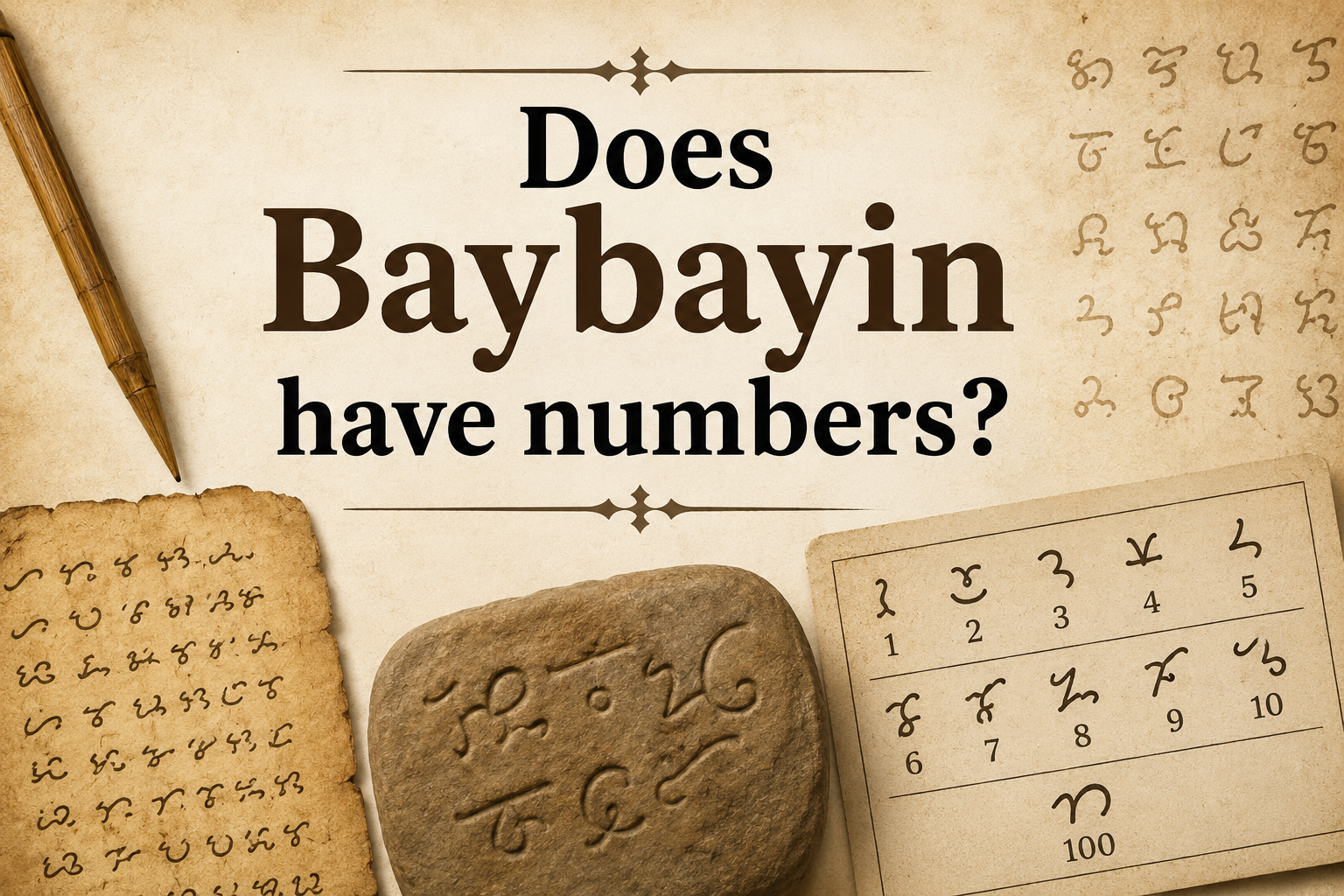
Does Baybayin Have Numbers? Baybayin Numbers 1–100 Explained
If you are learning Baybayin, you may eventually ask an interesting question: Does Baybayin have numbers? Can you write 1, 2, 3, 10, 100, or 1,000 in Baybayin? The short answer is that Baybayin did not historically use a separate set of numeral symbols like the modern digits 0–9.
Instead, historical Tagalog numbers could be written out as words, and those words could be written using Baybayin. Modern proposals for Baybayin numerals also exist, including a system known as Bulilağ or Bulilang, but it should not be confused with a proven ancient numeral system.
This distinction is important because many websites and social media posts present “Baybayin numbers” as though the symbols were an established precolonial numeral system. Let’s look at what the evidence actually tells us.
Does Baybayin Have Its Own Numerals?
Not in the same sense that we have the digits:
0 1 2 3 4 5 6 7 8 9
Baybayin is a writing system, not a complete mathematical notation system.
Historical evidence indicates that Old Tagalog speakers had sophisticated number words, but they did not simply adopt the Indic numerals associated with the broader Brahmic writing tradition. Instead, Old Tagalog numbers could be written as pronounceable words in Baybayin. A 2025 scholarly chapter on Philippine number systems notes that early Spanish missionaries recorded Old Tagalog number words, which were written in Baybayin rather than using Indic numeral symbols. (ResearchGate)
So if you want to represent the number 1, one historical approach is to write the Tagalog word for one:
- isa
Rather than looking for a special Baybayin symbol meaning “1.”
How Do You Write Numbers in Baybayin?
The simplest approach is to write the Filipino or Tagalog number word in Baybayin. If you want to convert Filipino words into Baybayin, you can use our Baybayin Translator.
For example:
The important point is that these are number words written in Baybayin, not separate Baybayin digit characters.
For example:
- isa → ᜁᜐ
- dalawa → ᜇᜎᜏ
- tatlo → ᜆᜆᜎᜓ
- apat → ᜀᜉᜆ᜔
- lima → ᜎᜒᜋ
- anim → ᜀᜈᜒᜋ᜔
- pito → ᜉᜒᜆᜓ
- walo → ᜏᜎᜓ
- siyam → ᜐᜒᜌᜋ᜔
- sampu → ᜐᜋ᜔ᜉᜓ
The exact appearance can depend on whether a traditional or later/reformed convention is being used, particularly for consonants at the end of words.
Baybayin Numbers 1–10
Here is a simple reference table:
|
Number |
Filipino/Tagalog |
Baybayin |
|---|---|---|
|
1 |
isa |
ᜁᜐ |
|
2 |
dalawa |
ᜇᜎᜏ |
|
3 |
tatlo |
ᜆᜆᜎᜓ |
|
4 |
apat |
ᜀᜉᜆ᜔ |
|
5 |
lima |
ᜎᜒᜋ |
|
6 |
anim |
ᜀᜈᜒᜋ᜔ |
|
7 |
pito |
ᜉᜒᜆᜓ |
|
8 |
walo |
ᜏᜎᜓ |
|
9 |
siyam |
ᜐᜒᜌᜋ᜔ |
|
10 |
sampu |
ᜐᜋ᜔ᜉᜓ |
This is the most useful way to think about “numbers in Baybayin” for modern learners:
number → Filipino number word → Baybayin writing
It is not:
number → special Baybayin digit
How Do You Write 11, 12, 20, and 100 in Baybayin?
The same principle applies to larger numbers. You first express the number as a Filipino/Tagalog word or phrase and then write that expression in Baybayin.
For example:
- 11 = labing-isa
- 12 = labindalawa
- 20 = dalawampu
- 21 = dalawampu’t isa
- 100 = isang daan
The Baybayin representation follows the words being written. This is why there is no simple historical equivalent of saying, “Here is the Baybayin symbol for 100.”
Instead, the number is expressed linguistically.
Research into Old Tagalog numerals shows that the traditional number system was considerably more complex than simply attaching digits together. Historical Tagalog had its own number expressions and counting structures, documented in early dictionaries and grammars. Jean-Paul Potet’s Numbers and Units in Old Tagalog, for example, examines historical numeral expressions using sources including works from the 1600s and the Noceda and Sanlucar dictionaries. (Google Books)
What About Baybayin Numbers 1–100?
If you search online for “Baybayin numbers 1–100,” you will find different kinds of results. Some pages simply list Filipino numbers from 1 to 100 and convert the words into Baybayin. That is a perfectly useful educational exercise.
But it is important to understand what those lists actually represent. They are generally Filipino/Tagalog number words written in Baybayin, rather than a historical list of 100 separate Baybayin numeral symbols.
For example:
- 1 → isa
- 10 → sampu
- 100 → isang daan
The Baybayin characters represent the words. This distinction prevents one of the most common misunderstandings about Baybayin.
Did Ancient Filipinos Have a Number System?
Absolutely. Not having separate digit symbols does not mean that people lacked mathematical or numerical knowledge. Historical research shows that Old Tagalog had a developed system of number words. Historical research shows that Old Tagalog had a developed system of number words. For more background, see the history of Baybayin and its cultural importance in the Philippines.
In fact, a 2025 study of Philippine number systems describes Old Tagalog counting as unusually complex, including several rules for constructing larger sets of numbers.
The issue is therefore not “Did Filipinos have numbers?” They certainly did. The more precise question is, “Did Baybayin have a dedicated set of numeral symbols?” The available evidence points toward no established historical set of separate Baybayin digits.
What Is Bulilang or Bulilağ?
This is where things get particularly interesting.
You may encounter the terms:
- Bulilang
- Bulilağ
When researching Baybayin numbers.
Bulilağ is associated with Guillermo Tolentino, who presented a Tagalog numeral system in 1937. A surviving Baybayin archive describes Tolentino’s system as Tagalog numerals and notes that its origin was not stated. The archive also records that the system was later printed on the cover of a Department of Education, Culture, and Sports high school algebra book in 1980. (rapcom-archives.blogspot.com)
So Bulilang is important to know about. But there is a major warning:
Do not automatically describe Bulilang as the ancient or precolonial Baybayin number system.
Its historical origin is uncertain, and the available documentation connects it to Tolentino’s 1937 proposal rather than establishing it as a numeral system demonstrably used by precolonial Baybayin writers.
Is Bulilang an Ancient Baybayin Numeral System?
This is one of the biggest misconceptions you’ll encounter online.
The answer should be:
There is no solid evidence that Bulilang was an ancient precolonial Baybayin numeral system.
Modern Baybayin communities still discuss this distinction. For example, recent discussions about writing dates and numbers in Baybayin continue to distinguish ordinary number words from Bulilang and describe Bulilang as a proposed system associated with Guillermo Tolentino. (Reddit)
Therefore, if you see an article claiming:
“These are the ancient Baybayin numbers 1–10.”
You should check whether it is actually talking about Bulilang. If it is, that claim needs qualification.
Why Do Some Websites Show Special Baybayin Number Symbols?
There are several reasons.
1. Modern proposals
People have created or promoted numeral systems for modern Baybayin use. Bulilang is one example.
2. Educational materials
A numeral proposal may appear in books, educational materials, artwork, or online resources and eventually be mistaken for an ancient system.
3. Modern design
Artists and Baybayin enthusiasts sometimes create systems that make Baybayin easier to use with modern numbers.
4. Internet repetition
Once an image labeled “ancient Baybayin numbers” spreads online, other websites may reproduce it without checking its historical origin.
This is why researching the source of a numeral system matters.
What Numbers Did Old Tagalog Use?
Old Tagalog had number words that differed from the forms most Filipinos use today. Historical dictionaries recorded older forms of numerals. For example, one documented older series gives:
- isain—one
- duwain—two
- mampat—three
- agiw—four
- tundong—five
- kala—six
- manapit—seven
- saga—eight
- bulaid—nine
- turo—ten
These forms are identified in historical lexicographical material as an older numeral series, although their antiquity and development require careful interpretation rather than simply assuming they were the everyday numbers used by every precolonial Tagalog community. (Wiktionary)
This is one reason historical Baybayin research can be much more complicated than simply converting modern Filipino words.
Can You Write Modern Numbers in Baybayin?
Yes. If your goal is modern artistic or educational use, you can write the Filipino number words in Baybayin. For example, 2026 can be expressed using Filipino words and then rendered in Baybayin.
The important thing is to decide what you want to represent:
- A. The numerical value
- B. The Filipino words for that numerical value
Traditional Baybayin is much more naturally suited to option B.
What About Dates?
Dates are one of the situations where people often want to use Baybayin numbers. For example, someone might want to represent July 11, 2026, in Baybayin.
There are several ways a modern designer might approach this, but there is no universally accepted ancient Baybayin digit system that lets you simply replace every Arabic numeral with a historical Baybayin character.
A historically cautious approach is to write the date using words. Alternatively, modern designers may use Arabic numerals alongside Baybayin text. For tattoos and artwork, this can actually be the clearest option.
Can You Write a Year in Baybayin?
Yes, but again, you need to distinguish between the number and the number word. For example, a year such as 1990 can be expressed verbally in Filipino and then represented using Baybayin.
But there is no historically established Baybayin equivalent of:
- 1 = symbol A
- 9 = symbol B
- 9 = symbol B
- 0 = symbol C
In the way that modern Arabic numerals work.
If someone shows you such a system, ask what historical source it comes from.
Why This Matters for Baybayin Tattoos
This subject becomes especially important when someone wants a date tattoo. A person may search “1962 in Baybayin” or “Baybayin numbers tattoo.” It is easy to find attractive-looking designs online, but appearance does not prove historical authenticity.
Recent Baybayin community discussions show people asking for help with dates such as 1962 and discussing whether to spell out the number, use modern numeral proposals, or use another numerical notation. If the tattoo is permanent, don’t choose a design simply because it looks ancient. If you are considering one, learn more about Baybayin tattoos before choosing a design.
Before choosing a design, first determine:
- What number you want to represent.
- Whether you want the Filipino number word or a numeric notation.
- Whether the writing is historical or modern.
- Which Baybayin convention is being used.
- Whether the source can actually be traced.
Baybayin Numbers vs. Filipino Numbers
These two ideas are often mixed together.
Filipino numbers
Filipino numbers are words such as
- isa
- dalawa
- tatlo
- apat
- lima
- anim
- pito
- walo
- siyam
- sampu
Baybayin
Baybayin is the writing system used to represent the sounds of a word. Baybayin is the writing system used to represent the sounds of a word. If you are new to the script, you can also learn more about the Baybayin alphabet.
Therefore, a Filipino number + Baybayin script = a number word written in Baybayin. This is the simplest way to understand the relationship.
Does Baybayin Have a Symbol for Zero?
There is no universally established historical Baybayin digit corresponding to the modern numeral 0. This is another reason that online charts showing “Baybayin 0–9” should be treated carefully.
If someone creates a modern numeral system containing a zero symbol, that does not automatically make it an ancient Baybayin character. For historical writing, the safer approach is to represent the concept using the appropriate word rather than claiming that a modern numeral design is an ancient character.
So, What Is the Correct Way to Write Numbers in Baybayin?
It depends on your purpose.
For historical accuracy
Use historically documented number words and write those words in Baybayin, while clearly distinguishing Old Tagalog forms from modern Filipino.
For modern Filipino writing
Use modern Filipino number words and render them in Baybayin.
For artwork
You can use a modern numeral proposal, but identify it as modern rather than presenting it as an ancient system.
For tattoos
Research the exact design carefully and verify its historical claims before making it permanent.
The Bottom Line: Are There Baybayin Numbers?
Here is the simplest answer:
Baybayin does not have a historically established set of separate digit symbols equivalent to 0–9.
Historically, numbers could be written as number words, and those words could be written using Baybayin.
There is also a modern numeral proposal known as Bulilağ/Bulilang, associated with Guillermo Tolentino’s 1937 work. However, its historical origin is uncertain, so it should not automatically be presented as an ancient precolonial Baybayin numeral system.
So when someone asks, “What is 1 in Baybayin? ”, the historically careful answer is not necessarily to give them a special “Baybayin digit.” Instead, you can write the Filipino number word:
isa → ᜁᜐ
And for:
2 → dalawa → ᜇᜎᜏ
The Baybayin characters represent the word, not functioning as a modern Arabic-style digit.
Frequently Asked Questions
Does Baybayin have numbers?
Baybayin does not have a historically established set of separate numeral digits like 0–9. Number words could be written using Baybayin.
How do you write 1 in Baybayin?
The Filipino word for “one” is “isa,” which can be written as ᜁᜐ.
How do you write 10 in Baybayin?
The modern Filipino word “sampu” can be written in Baybayin as ᜐᜋ᜔ᜉᜓ using a modern virama convention.
Does Baybayin have a symbol for zero?
There is no universally accepted historical Baybayin digit for zero.
What is Bulilang?
Bulilang, also written Bulilağ, is a proposed Tagalog numeral system associated with Guillermo Tolentino in 1937. Its historical origin is uncertain, and it should not automatically be described as an ancient Baybayin numeral system.
Can I write 1–100 in Baybayin?
Yes. You can write the Filipino number words for 1–100 in Baybayin. This is different from having 100 separate Baybayin numeral symbols.
Were numbers written in Baybayin historically?
Historical research indicates that Old Tagalog numbers could be written as pronounceable words in Baybayin rather than using Indic numeral symbols.
Can I use Baybayin numbers for a tattoo?
You can use number words written in Baybayin or a modern numeral proposal, but you should verify which system you are using. Do not assume that every “Baybayin numbers” chart online is historically ancient.
Conclusion
Understanding Baybayin numbers becomes much easier once you distinguish between numbers, number words, and the writing system used to represent them. Filipino number words such as isa, dalawa, tatlo, sampu, and isang daan can be written using Baybayin, while modern numeral proposals such as Bulilang belong to a different historical category.
When you encounter a chart claiming to show “ancient Baybayin numbers,” it is important to look beyond the symbols themselves and ask where the system comes from. What is the historical source for these symbols?
That distinction can help separate documented Baybayin history from modern numeral proposals and internet myths.