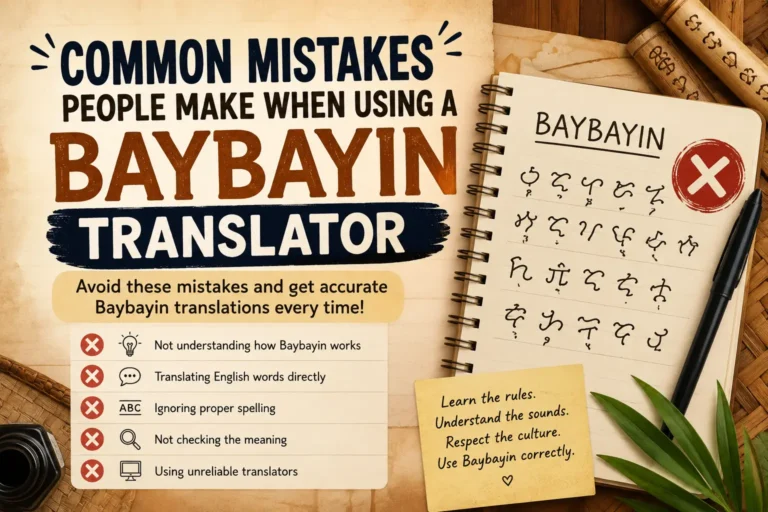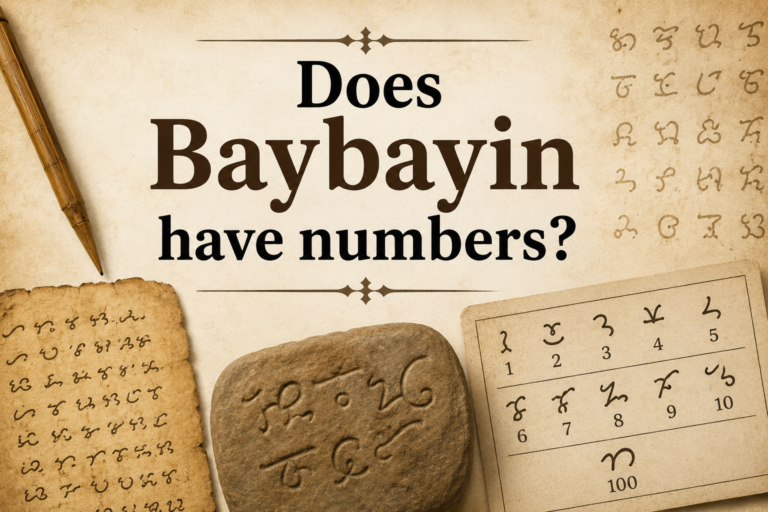
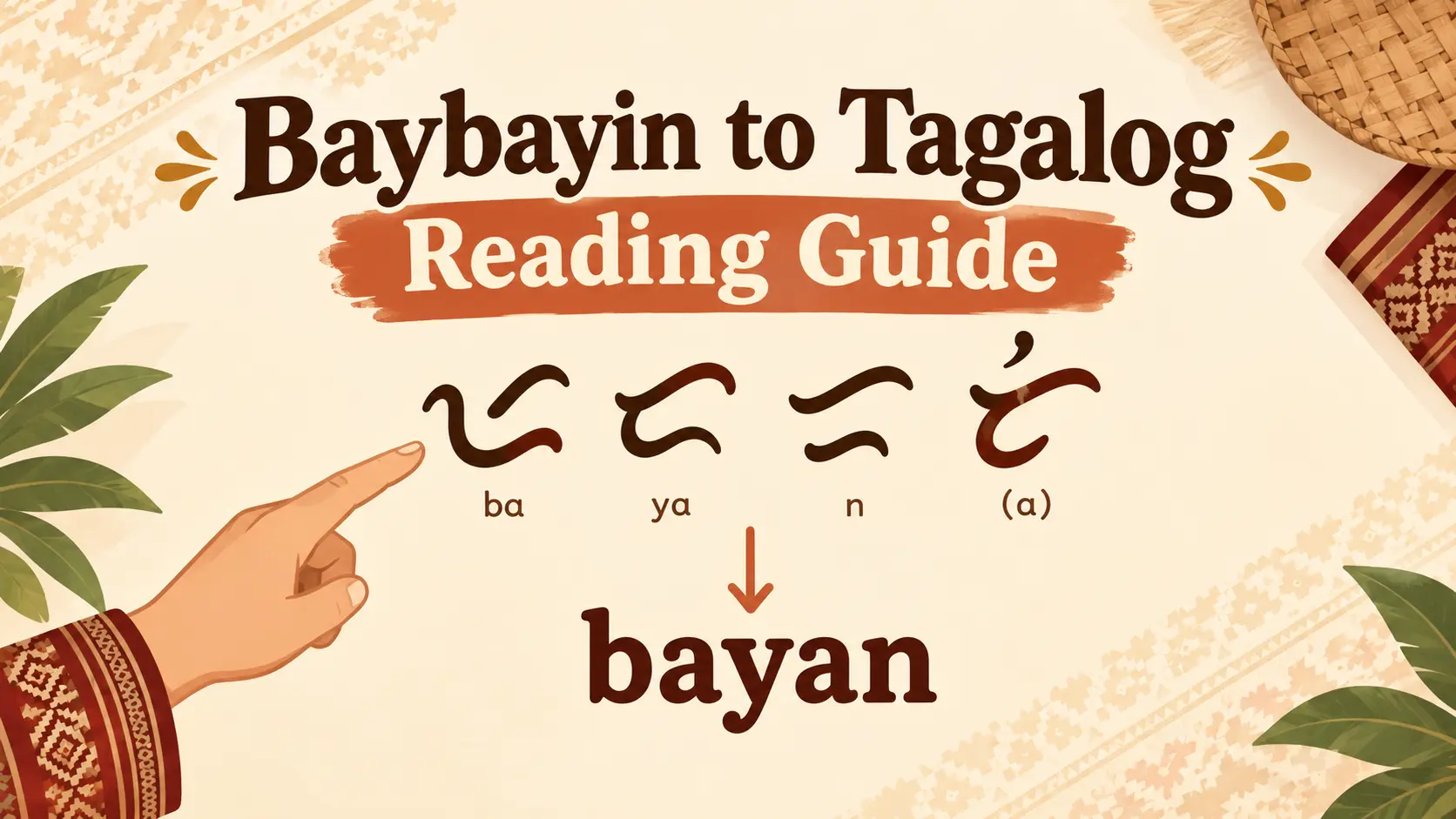
Baybayin to Tagalog: How to Read Baybayin Script Back Into Text
If you have a string of Baybayin characters and want to know what they say in Tagalog, you are doing the reverse of what most Baybayin tools are built for. Most online converters go one direction only, from Latin letters into Baybayin. Reading Baybayin back into Tagalog means working through the same rules in reverse, character by character, using the sound each symbol represents.
This guide walks through exactly how that works. If you want to go the other direction and see how a Tagalog or English word looks in Baybayin, our Baybayin Translator on the homepage generates that instantly. This article focuses on the opposite skill, reading Baybayin and turning it back into readable Tagalog text.
What “Baybayin to Tagalog” Actually Means
Baybayin is a script, not a separate language. It was historically used to write Tagalog and other Philippine languages, the same way the Latin alphabet is used to write English or Spanish. So “translating” Baybayin to Tagalog is not really translation in the usual sense. It is transliteration, which means converting written symbols back into the sounds they represent, then recognizing the resulting word.
This distinction matters because a string of Baybayin characters does not carry meaning on its own the way a Chinese character might. It only tells you how a word sounds. Once you sound it out, you still need to recognize the Tagalog word itself.
How Baybayin Represents Sound: A Quick Refresher
Before reading Baybayin, it helps to remember the three rules that govern how each character behaves.
The Default Vowel Is “A”
Every basic consonant character in Baybayin carries a built-in “a” sound unless it is marked otherwise. A character that looks like the symbol for “B,” for example, is read as “ba” by default.
A Kudlit Changes the Vowel
A small mark called a kudlit, placed above or below a character, shifts that default “a” sound. A kudlit placed above the character changes it to an “i” or “e” sound. A kudlit placed below changes it to a “u” or “o” sound. For a full breakdown of every character and its marks, our Baybayin alphabet guide covers the complete set.
A Virama Cancels the Vowel
In traditional Baybayin, there was no way to write a consonant without a vowel attached. Modern usage added a mark, often written as a small cross or “+” symbol beneath the character, called a virama or krus-kudlit. This cancels the vowel entirely, leaving just the consonant sound. Without this mark, older or more traditional Baybayin text may drop final consonants altogether, which is one reason reading historical inscriptions can be genuinely difficult even for fluent Tagalog speakers.
Step-by-Step: Reading Baybayin Back Into Tagalog
- Identify each character. Break the Baybayin string into individual symbols rather than trying to read it as a whole word at first.
- Check for a kudlit. Look above and below each character. No mark means the default “a” sound applies.
- Check for a virama. If a cross or cancellation mark appears beneath a character, that consonant has no vowel attached.
- Sound out each syllable in order. Read left to right, combining the syllables as you go.
- Match the sound to a real Tagalog word. This last step is where context and vocabulary knowledge matter most, since Baybayin only tells you the sound, not the spelling convention or meaning.
Worked Examples
|
Baybayin Reading (syllable by syllable) |
Sounds Out To |
Tagalog Word |
|
ma + bu + ha + y (virama) |
ma-bu-hay |
mabuhay |
|
ma + ha + l (virama) |
ma-hal |
mahal |
|
sa + la + ma + t (virama) |
sa-la-mat |
salamat |
|
pu + so |
pu-so |
puso |
Notice that the final consonant in “mabuhay” and “salamat” only appears correctly if the virama is present. Without it, the same characters would simply read as “mabuha” or “salama,” which is why the virama matters so much for accurate reading of modern text.
Common Mistakes When Reading Baybayin to Tagalog
Ignoring the Kudlit position. A kudlit above and a kudlit below look similar at a glance but change the vowel in opposite directions. Misreading the position is one of the most frequent errors beginners make.
Assuming every consonant carries a vowel. Older or more traditionally styled Baybayin text sometimes drops the virama entirely, following pre-colonial convention. If you are reading historical text rather than a modern translator’s output, expect final consonants to be implied rather than written.
Treating the result as a guaranteed spelling. Because Baybayin represents sound, more than one Latin spelling can sometimes fit the same set of characters. Reading Baybayin gets you very close to the word, but confirming the exact Tagalog spelling still depends on recognizing the vocabulary itself.
Expecting a direct meaning. Sounding out a name or foreign word correctly does not mean it “means” anything in Tagalog. Baybayin represents pronunciation, not translated meaning, which is a distinction worth keeping in mind whenever you see a Baybayin phrase shared online.
Why There Isn’t Always One Single Correct Answer
Because Baybayin is sound-based, the same set of characters can sometimes be read more than one way, especially with names, loanwords, or text written without a virama. Regional spelling habits and the specific writing convention used (traditional versus modern with virama) can also affect how a string of characters should be read.
If you are working from a tattoo, an old document, or a piece of art and the reading is unclear, cross-checking against a modern Baybayin translator in the forward direction, typing the Tagalog word you suspect it says, and comparing the output is a practical way to confirm your reading.
Frequently Asked Questions
1. Is there a tool that translates Baybayin to Tagalog automatically? Most Baybayin tools, including ours, are built to convert Tagalog or English into Baybayin rather than the reverse. Reading Baybayin back into Tagalog currently relies on knowing the character set and applying the rules above.
2. Is Baybayin to Tagalog really a translation or something else?
It is transliteration, not translation. Baybayin represents the sounds of Tagalog words, so reading it back is closer to sounding out a word than translating between two different languages.
3. Why do some Baybayin words look like they are missing letters?
Traditional Baybayin did not mark final consonants at all. If a piece of text follows the older convention rather than using a virama, syllables like “mabuhay” may appear to read as “mabuha” unless you know the intended word from context.
4. Can I read Baybayin if I do not speak Tagalog fluently?
You can sound out the characters using the rules in this guide, but recognizing the resulting word as correct Tagalog vocabulary is much easier with at least a basic familiarity with the language.
5. Is Baybayin to English possible using the same method?
Not directly. Baybayin represents Tagalog and related Philippine language sounds. English words would need to already be spelled phonetically in Baybayin first, and reading that back gives you the sound, not an English translation.
6. Do different Baybayin fonts change how a word reads?
The underlying characters and rules stay the same across fonts. What changes is stroke style and visual presentation, not the sound each symbol represents.
Conclusion
Reading Baybayin back into Tagalog comes down to three things: recognizing each character, checking for kudlit and virama marks, and matching the resulting sound to a real word. It takes practice, especially with older text that skips the virama, but the rules themselves are consistent once you know them.